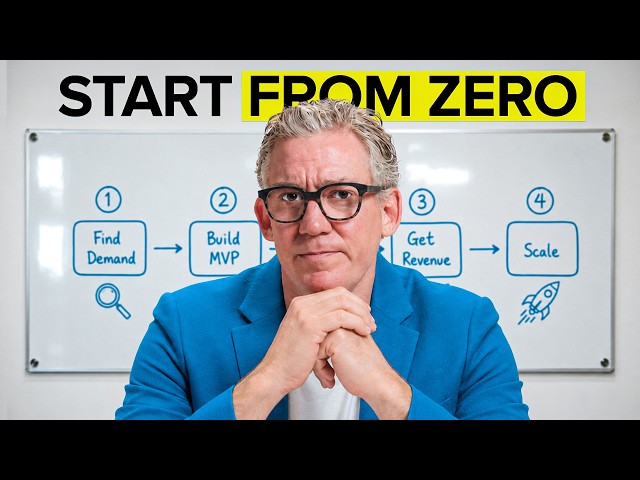
A business can post strong EBITDA figures while quietly running out of cash. David Heacock, who generates $23 million a month selling air filters through his company Filterbuy, opens with that warning: EBITDA can look healthy while the underlying business bleeds cash, sometimes all the way to bankruptcy(0:22). That tension between reported profitability and actual cash position anchors the financial framework he lays out across the episode.
The EBITDA Problem
EBITDA, Earnings Before Interest, Taxes, Depreciation, and Amortization, strips out several real costs that determine whether a business actually survives. Heacock's concern (0:22) is that founders and investors who rely on it as a primary health metric can miss deteriorating cash flow until it is too late. Debt service, capital expenditures, and working capital requirements do not appear in EBITDA, which means a capital-intensive manufacturer, for instance, could show a strong EBITDA number while its bank account empties.
The practical implication Heacock draws from this is a focus on gross margin as an earlier and more reliable signal. He states that businesses worth pursuing generally carry a gross margin of at least 50% (2:17). Below that threshold, the room to absorb overhead, debt service, and reinvestment shrinks fast. For a manufacturing business like Filterbuy, where raw material costs and logistics are constant pressures, that margin floor is not aspirational, but it is structural.
“EBITDA can look great while the business bleeds cash, leading to potential bankruptcy despite strong EBITDA figures.”
Buy-Borrow-Die: How Wealthy Individuals Avoid Taxes on Appreciated Assets
The second major framework Heacock explains in depth is the buy-borrow-die, a tax strategy used by high-net-worth individuals to fund consumption without triggering capital gains events. The mechanics are straightforward: buy appreciating assets, borrow against them at low interest rates to fund living expenses (borrowing is not a taxable event), and hold until death, at which point heirs receive a stepped-up cost basis that erases the embedded gain.
Heacock has addressed the relationship between debt and wealth-building before. In an earlier episode on using debt as a wealth tool, he argued that cash is a liquidity tool, not a wealth-building tool, and that the wealthy use debt to fund assets that generate returns rather than to fund lifestyle directly. Buy-borrow-die is the logical extension of that position applied to the tax code: the loan proceeds fund the lifestyle, the asset continues to compound, and the tax liability disappears at death.
The strategy requires assets that lenders will accept as collateral at favorable loan-to-value ratios, typically publicly traded securities or real estate with established appraisals. For business owners whose wealth is concentrated in a private company, accessing the strategy means either taking the company public, pledging other assets, or building a parallel investment portfolio liquid enough to borrow against.
Differentiation as a Business Prerequisite
Running through Heacock's monolog is the argument that imitation is not a viable business strategy. He is direct about it:
“If you're just copying what everybody else is doing, you've already lost.”
The context is his broader view on competitive positioning: unique insight, not execution speed, is what creates durable advantage. Heacock has made a version of this argument across much of his recent output. When he examined what makes certain boring businesses nearly failure-proof, he identified recurring demand, customer pain, and documentation complexity as the structural features that protect a business from commoditization. Copying a business model that lacks those features, he implies, just replicates someone else's vulnerability.
The operational corollary he offers is focus: "You need to pick your lane and compound against that one vision"(15:34). Filterbuy itself is an example of that principle applied over time. As Milimgo reported in prior coverage, Heacock's company crossed $1 billion in cumulative air filter sales by staying in a single, unglamorous product category and compounding operational improvements rather than diversifying into adjacent markets.
The three frameworks, gross margin as a floor, EBITDA as an incomplete signal, and buy-borrow-die as a tax-deferral mechanism, are each well-established in finance. What Heacock adds is the perspective of someone running a high-volume manufacturing operation who has encountered the limits of each metric firsthand. The 50% gross margin threshold, in particular, is not a theoretical preference; it is the number he applies when evaluating whether a business is structurally worth pursuing at all.